Storage.com
Clear the clutter. Keep what matters.
Compare U.S. storage units for the furniture and seasonal gear you want to keep after a cleanout.
Compare nearby storage unitsEstimate your load by metal type and weight before you sell
Multiply each accepted metal grade's weight by its quoted price, then add the amounts. Keep the units consistent: a per-pound rate needs pounds, while a per-kilogram rate needs kilograms. A mixed load should not all be priced at its most valuable metal's rate.
For example, 200 pounds of aluminum at an entered $0.50 per pound is $100. If a separate 10-pound copper lot is quoted at $3 per pound, add $30 for a $130 total before deductions. These are example inputs, not current prices. Use the actual grade and local quote rather than a generic metal name.
Specialty materials such as titanium need alloy identification and a buyer that accepts them. Clean solids and contaminated turnings may receive different terms; do not substitute a copper or steel rate. Read the titanium scrap value and recycling guide for alloy, weight, and quote comparisons. For a complete vehicle, use the junk and scrap car calculator. Manufacturing scrap percentage is a reject-rate calculation, not a metal-value estimate.
Selling a complete vehicle? Check your junk car value before accepting an offer. Compare the amount you would receive after towing and fees with local buyers' written quotes.
We updated common reference prices on 11/4/2026 using public U.S. yard boards. Local yards set their own payouts by grade and buyer. See current prices.
The calculator multiplies the weight of each metal by its estimated price per pound, then adds the results for your total load. For example, 10 pounds of aluminum cans at the current $0.84-per-pound reference rate produces an estimated value of $8.40.
Select the closest match, such as bare bright copper, insulated wire, aluminum cans, or stainless steel.
Use a scale when possible. Convert ounces, kilograms, or tons inside the calculator.
Scrap yards set their own prices and grading rules. Call nearby buyers before hauling a large load.
Next step
Have a whole junk car? Compare the full-vehicle offer.
Sponsored · Peddle
Skip parting it out. Peddle buys the whole vehicle with free pickup. Instant online offer in minutes, running or not.
4.7/5 across 200,000+ Trustpilot reviews, A+ with the BBB
Buying cars since 2004, over 4.5 million cars and counting
The prices above are estimates based on as-is condition. Simple processing can increase your payout by 50-100%.
Insulated wire: $1.80-2.50/lb
Stripped bare copper: $3.30-4.48/lb
That's 70-100% more value!
Manual strippers work for small amounts. For regular processing, powered strippers process 10x faster.
Weigh at home before visiting the yard. Prevents disputes and helps you negotiate confidently.
Use our Item Scrap Value Lookup tool to find estimated weights and values for 150+ common items including cars, appliances, copper wire, aluminum cans, and more.
Search Items by Name →Today's per-pound prices for copper, aluminum, steel, brass, and more.
Industry pricing trends and analysis for serious sellers.
Identify and prep ferrous and non-ferrous metals for the best price.
Expert tips for sorting, processing, and selling scrap profitably.
Weight times a per-pound price for the grade you bring in, minus any deductions. Yards sort by metal type and cleanliness, and a mixed or dirty load is paid at the lowest grade present. Yards also buy below the commodity market price, because their margin is the spread between what they pay you and what they get from the mill, plus their sorting, transport, and overhead costs.
Distance to the mill, processing capability, and how much volume they move. A yard that can shear and bale sells directly to a mill; one that cannot has to sell on to a larger processor and pays you less. Local competition matters too. Differences of 10% to 40% between yards in the same region are normal, so calling three before a large load is worth the time. On a single bucket of cans it rarely is.
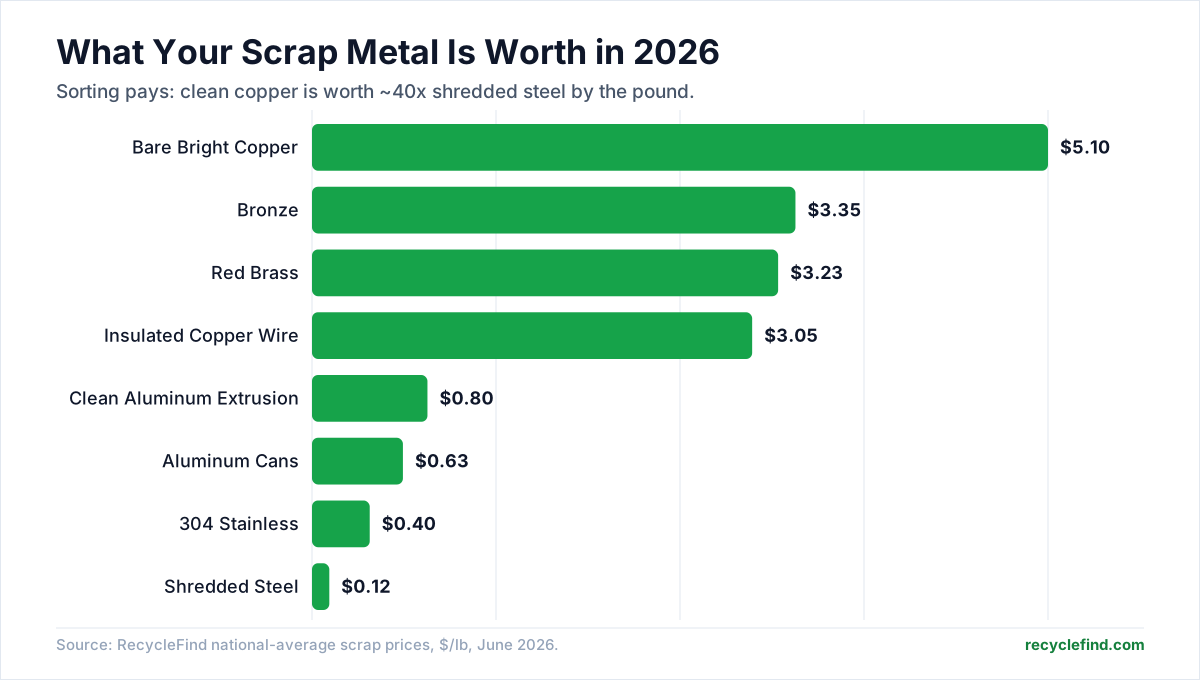
Ferrous metal contains iron and is magnetic: steel, cast iron, and most appliance and vehicle bodies. Non-ferrous metal is not magnetic and includes copper, aluminum, brass, and lead. Ferrous is bought by the ton for cents per pound, while non-ferrous is bought by the pound and can be worth fifty times as much. A magnet is the fastest sorting tool you own: if it sticks, expect ferrous pricing.
It depends on the wire and on what your time is worth. Stripped bright copper pays more per pound than insulated wire, but thin wire has a low copper recovery rate, so you can spend an hour stripping for a few dollars of gain. Thick, low-count cable is usually worth stripping; thin multi-strand wire usually is not. Test a short length first, weigh the copper you recover, and decide from the actual ratio rather than a guess.
Sort by metal and grade, and keep the grades physically separate so nothing gets downgraded by association. Remove attachments that are not the metal you are selling: plastic, rubber, wood, and steel fittings on non-ferrous items. Drain fluids. Keep clean copper away from anything that would contaminate it. Preparation is where most of the avoidable money is lost, because a yard will not sort your load for free, they will pay you the lower rate.
Almost always. Most states require scrap dealers to record a government photo ID and keep a transaction record, and many require payment by check or hold a waiting period on certain items rather than paying cash immediately. Catalytic converters, copper wire, and metal with a plausible stolen origin carry the strictest rules. Expect to show ID for any material and to answer questions about where it came from.
Treat them as a benchmark, not a quote. They are U.S. national averages, and scrap markets move continuously with commodity prices, export demand, and local mill activity. Your payout also depends on grade, preparation, and volume. Use the estimate to know roughly what a fair offer looks like and to spot one that is clearly low, then confirm the current rate by calling the yard.
Compare gold melt value with a realistic buyer payout by karat and weight.
Calculate sterling and coin-silver melt value, fees, and likely cash payout.
Instant scrap value estimates for 80+ items, from copper wire to appliances.
Compare insulated wire with stripped copper and include the value of your time.
Estimate brass value by grade, weight, and preparation before you visit a yard.
Current copper, aluminum, brass, and steel prices by grade.
RecycleFind grade prices are a starting point. These guides cover identification, stripping, and larger loads.
Identify common metals, build a safe starter kit, and understand how yards buy scrap.
Learn grading, sorting, sourcing, and margin practices that matter on larger loads.
Learn when stripping pays, how to test a sample, and how to prepare wire safely.
Follow the market forces behind changing copper, aluminum, steel, and brass prices.
Sponsored · Peddle
Get an instant offer online in minutes. Fast, free pickup, payment on the spot, running or not.
4.7/5 across 200,000+ Trustpilot reviews, A+ with the BBB
Buying cars since 2004, over 4.5 million cars and counting
Clear the clutter. Keep what matters.
Compare U.S. storage units for the furniture and seasonal gear you want to keep after a cleanout.
Compare nearby storage unitsPut organic produce on your weekly menu
Explore Full Circle farm boxes and check delivery for your ZIP code.
Check delivery in my ZIPCarry your everyday essentials in a vegan bag
Explore Svala handbags and totes for errands, work and weekends away.
Shop Svala bags